Data Acquisition / Programmable Controller / ioPAC 6500 Series (65M) CPU Modules
ioPAC 6500 Series (65M) CPU Modules
CPU modules for modular programmable IIN controllers
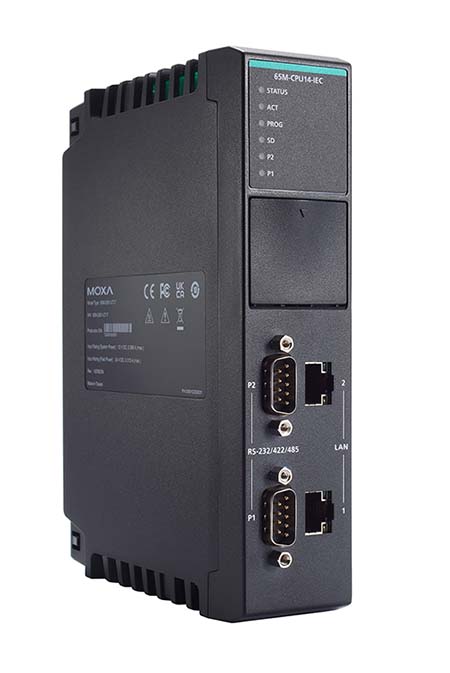
Features and benefits:
- Supports multiple IT/OT protocols for seamless communication between SCADA, Plant Information System, and cloud applications
- Tool-free hardware installation and hot-swap design for maximizing operation efficiency
- Fully modular design for maximum deployment flexibility
- IINxpress IDE utility combines IEC 61131-3 programming, configuration, and protocol services to streamline workflow and reduce programming efforts
- Enhanced security with built-in functions including Secure Boot, password-cracking defense, intrusion detection, and DoS defense
Certifications


DATASHEET DOWNLOAD GET A QUOTE
Introduction
The ioPAC 6500 Series (also referred to as Intelligent Integrated Node or IIN) is an advanced Linux-based RTU featuring a built-in Layer-2 managed switch. Equipped with an Arm Cortex-A53 quad-core CPU, the ioPAC 6500 Series delivers robust performance.
6C Competencies
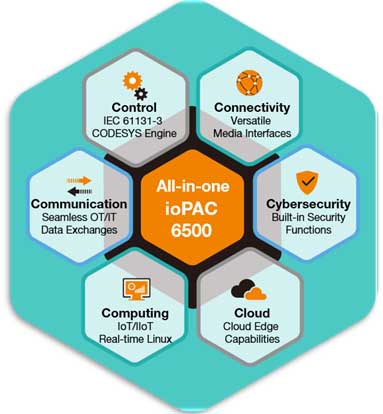
The ioPAC 6500 Series delivers the following competencies to your projects:
- Control: Precision control of your equipment
- Communication: Protocol support to connect to other devices and systems
- Computing: Applications for computing and data processing
- Connectivity: Versatile set of media interface
- Cloud: Cloud connectivity and cloud edge computing
- Cybersecurity: Security features to protect the devices and data
Fully Modular Design
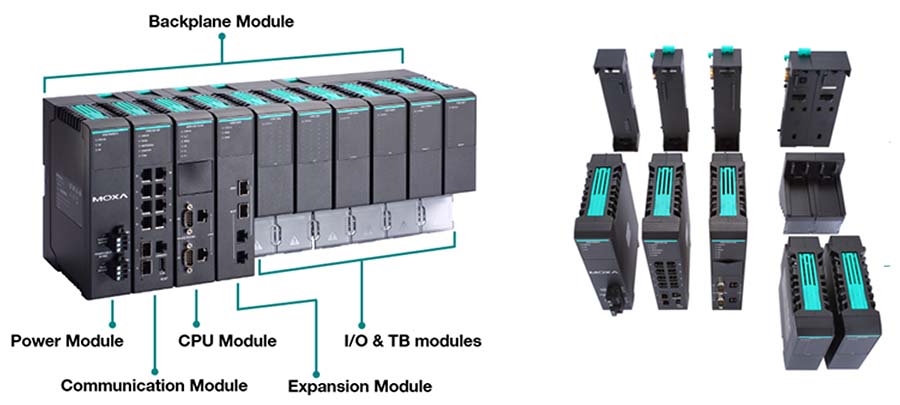
The ioPAC 6500 Series features a unique Lego-like mechanical design that allows for flexible deployment while minimizing installation efforts. The series can be divided into the components: Backplane modules, power modules, communication modules, expansion modules, CPU modules, I/O modules, and terminal-block modules.
IEC 61131-3 Automation Programming
The ioPAC 6500 Series features IEC 61131-3 automation programming for flexibility in automation design and consistency in syntax and semantics, promoting interoperability between systems, thereby reducing development complexity in automation projects. Five languages are available: LD, FBD, SFC, IL, and ST, allowing automation professionals to choose the programming language that best suits their needs.